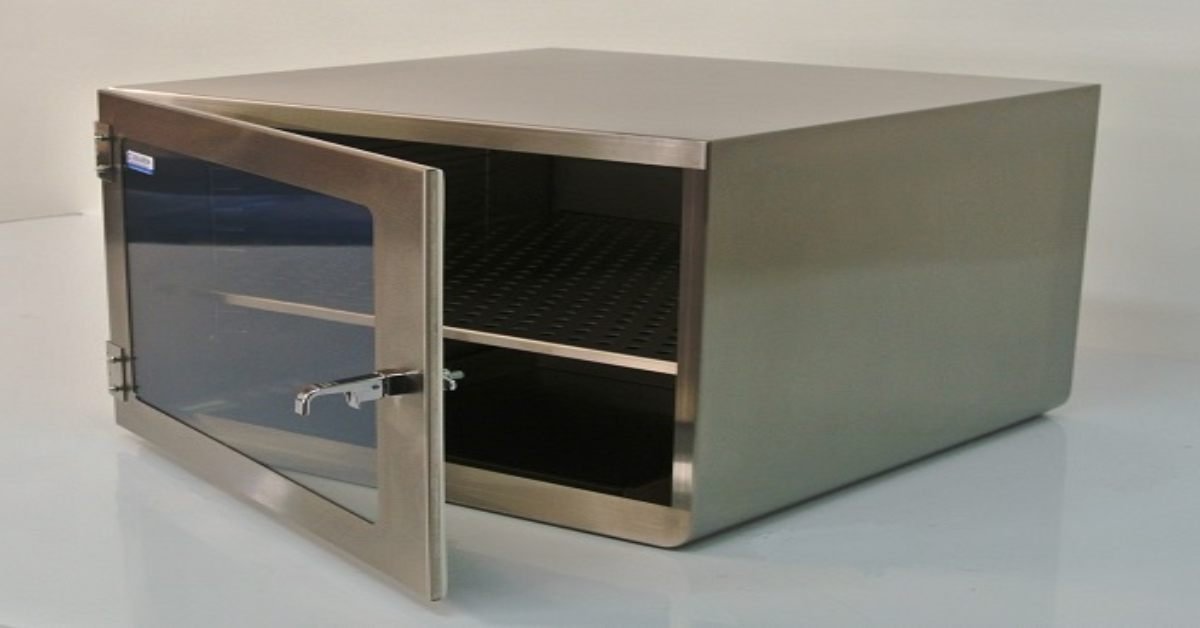
It is used for slow drying at room temperature, storage of hygroscopic compounds, in gravimetry. When it is important to prevent saturation of the test substances with an indefinite amount of water from the air, as well as in soil science to record the WRC curve. For some purposes, it is possible to create a vacuum inside the Desiccator.
A Special Shape
The Desiccator has a special shape to accommodate a lattice porcelain tray on which the bottles are installed. At the bottom of the Desiccator, a hygroscopic substance is placed for drying or a solution that maintains a certain partial pressure of water vapor.
One of the main activities of Stainless Steel Desiccators is the production of acrylic vacuum desiccators, tabletop classic desiccators and PVC desiccators for researching laboratories of various profiles.
What is the Desiccator
Desiccator is a type of equipment that serves for long-term storage and transportation of samples (materials) in an air environment with low humidity, inert gas or vacuum. Stainless Steel desiccator manufactures acrylic or polyvinyl chloride desiccators for a wide range of industrial and R&D lab applications:
The vacuum Desiccator is designed for storing samples. And conducting research in a vacuum or inert gas environment. Vacuum desiccators are equipped with pressure gauges with a reading range from 0 to -0.1 MPa. And valves for supplying and removing inert gas (air). This type of Desiccator ensures maximum operator safety thanks to the reinforced Desiccator design and reliable seals. Acrylic vacuum desiccators are available in rectangular, square. And cylindrical shapes, ranging from 50 ml to 40 liters, providing a choice of Desiccator models to suit any application. The Desiccator can be fitted with sealed power outlets for connecting auxiliary equipment. The location of the outlet is agreed upon additionally when placing an order for production.
Using the Automatic Desiccator
An automatic Desiccator is required for storing samples in an air environment with humidity of 30 to 40%, which is ensured by continuous air circulation inside the Desiccator. Automatic desiccators have a high moisture absorption capacity, providing optimal conditions for storing samples for a long time.
Desiccators of this type are available in transparent or tinted polyvinyl chloride (PVC). For the convenience of work, horizontal and vertical models of desiccators are produced. To optimize the working space, up to 15 shelves can be installed in desiccators, an example of such an automatic Desiccator is the Auto A-3W or Auto C-3W models.
The classic Desiccator is used to store samples. To absorb moisture and maintain the required air humidity, a tray with a desiccant. Such as silica gel, is installed inside the Desiccator. Desiccators can hold up to fifteen shelves. Classic desiccators are lightweight, compact and easy to handle.
A floor-standing Desiccator (or dry storage cabinet) is designed for long-term storage of samples in an environment with a humidity of 30-40%. Classic models are available in which silica gel is used as a desiccant. As well as automatic floor desiccators with an air drying system and desiccators designed to work in an inert gas environment.
The Ones with Stainless Steel
Stainless Steel Desiccator has also released a range of portable desiccators for transporting samples or parts in low humidity, inert gas or vacuum environments. Lightweight and handy portable desiccators will be an indispensable companion in any laboratory.
Along with vacuum desiccators, automatic desiccators, floor-standing dry storage cabinets. And portable desiccators, we supply all the necessary accessories. And spare parts for them: hygrometers, silica gel, hand vacuum pumps, taps, pressure gauges, flow meters, vacuum packaging (bags and containers) and others.
Accessories
The air contains a certain amount of moisture. This is why mould can develop on a seemingly dry surface, and iron begins to rust. If you are dealing with chemicals, this becomes a problem; even a small amount of water can cause a chemical reaction. But before you use a Desiccator in a chemical laboratory, you must understand what it is.
Conclusion
The Desiccator is usually a sealed enclosure that has no moisture inside. The main function of a Desiccator is to remove moisture from a substance or to protect this substance from moisture. Some chemicals begin to degrade when exposed to moisture for a long period of time. A very slow variation of this type of rust reaction appears on iron when exposed to water. The air around us contains trace elements of moisture. So some substances cannot be stored openly, and then a Desiccator comes to the rescue.